I know this title at first might be a bit confusing, but in a few moments it will become clear. There is a little bit of back story to this post and while doing my utmost to keep it concise, I will also make sure it isn’t boring to read. So where do I begin? At Christmas my very good friend as his girlfriend bought me a box of mindfulness cards. Being the curious man that I am, I looked at my wife and said rather than a month, I’m gonna do this for a year. Why are year? Well mainly because while forming new habits can be done in a short amount of time, maintaining those habits is much more difficult and I wanted to see what would happen and how I would feel if I could continue this on for a whole year. In the spirit of goodwill, I extended the invitation to me friend and asked if he’d like to join me and just see how we both get on. Luckily he agreed as we began going through the mindfulness cards. After the first month the cards kinda ceased having a purpose and we had already begun looking at other mindful exercises. This isn’t to say the cards were useless, far from it! The cards had simply given us the first steps that we needed to carry on going our own way. If not for the 30 wonderful cards, I might not be the man I am…3 months later. I know, I know it is only April, it hasn’t been a year, but hear me out. Through the daily journal we’ve been keeping, we both noticed changes in ourselves and after sharing this entry from the 28th of March, my buddy suggested using this entry as a blog post. So here it is. Was that concise? ummm…yes.
I know this isn’t really a commentary on Stoicism, but if I’m perfectly honest, I’ve never been a quick researcher and putting the topics together for each post seems to have taken me longer than I thought it would. So, I’m gonna fill some gaps and at least write something to make it look like I haven’t totally neglected the blog.
So lets begin. Mindfulness inspirations can often come from the most unlikely places, and reflecting on those unlikely things can often yield just as good of a reward. So on the 28th of March, this is what we reflected on.:
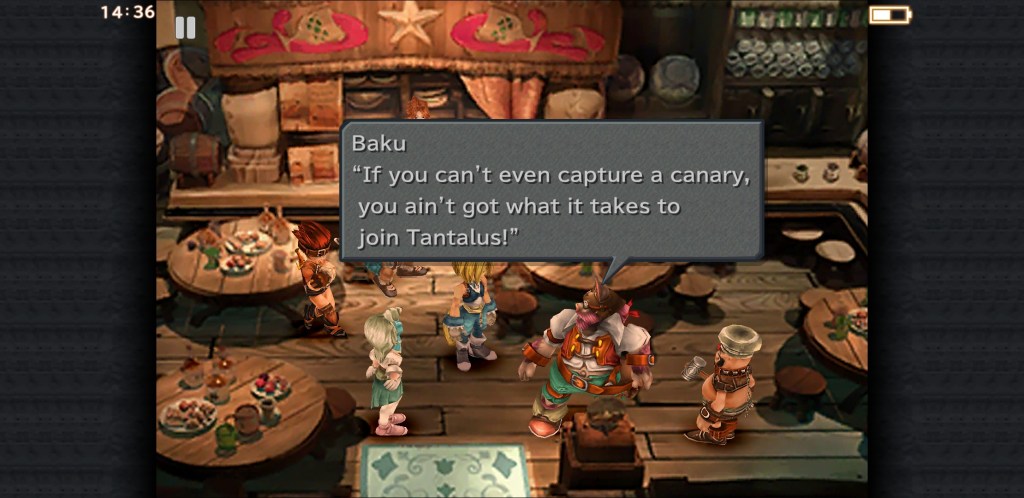
If you can’t even capture a canary, you ain’t got what it takes to join Tantalus
-Baku, Final Fantasy 9
As a side note, and this is going to be a long side note. Final Fantasy 9 is without a doubt my favourite game of all time. I would like to have an accurate figure of how many times I’ve played it over the years, but I just don’t. The number of times played though is unimportant compared the reasons I keep going back to the game. To me it is the perfect story in which the every day issues of existential angst are confronted by each character and also by us as we walk alongside them on their journey. While at first I may not have understood the purpose of Vivi’s quest for self discovery and his wish to assert at least some part of himself on the world to prove that he was real and that he existed, I resonated with his will to do what he intended and his initial fear at doing that. Not only that, we learn through his learning of what it means to live and die. It is as if, through the characters in the game, we are being by them as well as the characters. Their teachers are our teachers. In his heart melting conversation with Mr 288, who tells him:
‘I don’ t know… Fear? I don’t want to stop. And maybe I want to run away from it all. But living in the village with everyone fills me with joy. The joy of living with them far outweighs the fear of death. Isn’t it the same for you? Traveling with your friends gives your life meaning.’
Mr 288

Through this we learn about the natural cycle of birth and death, coupled with the fact that we cannot escape our own eventuality. What comes after we die? Is there an afterlife? Do we come back? What happens to those we leave behind? Take your stance on that as you will, but the game kinda just says, regardless of what happens, its okay that it happens that way. The meaning to all of it, is found where we are, not where are going. Do the things that make you happy and be with the people that bring you joy. The story at first, carries a light hearted tone, and doesn’t appear to carry the depth we find later in the game. However, this is perhaps one of the most imporant aspects of the game and it teaches us, that no matter how good life is at some point, there will be a time in which we must confront ourselves and our mortality and a desire to find meaning in a world that appears to not want to give us one. I feel like if Albert Camus were alive, he’d quite enjoy this game. As we reach the final chapter of the story, we bare witness to the terror of being unable to accept our only certainty, that we must at some point die. Watching Kuja fall into his crippling, perhaps insane pit of dispair at being unable to come to terms with his finiteness, we too are confronted with the same question, are we afraid of dying to the point where everyone must perish if we are to do so? How do we acknowledge this fear in ourselves? what does the fear mean? More importantly of course, can we overcome it? This confrontation is fully realised in the controversial appearance of Necron. So I’m going to go balls out here and state for the record, that not only is Necrons appearance is appropriate, by God it is a down right necessity to fulfil the journey the characters have been on. To not include him in the final segment of the game would be insult the trauma our characters have overcome and that we have over come with them. In standing on the hill of despair and staring into the barrel of their own mortality, they affirm their right to live thereafter. Like in our own lives, the characters cannot be free to live how they wish if the dread of the ever present shadow of death looms over them. As Necron nicely reminds us, he will always be perpetually present so long as we try to run from our fate, for as long as their is life, there must also be death. Like with Camus and his book The myth of sisyphus, the absurd will always be there, but it is up to us in whether or not we accept it and live the remainder of our lives fulfilling our own meaning, or rejecting it and well, just being down right miserable along the way. Necron, is the result of the confrontation with mortality, staring back at us. Heavy stuff. Dick jokes on the way, I promise.

The truth is though, for me personally the game helped me over the years to learn to understand my own worries of death so much so, that my dissertation was on my journey of fearing death to understanding it. So, how does this link to what I was saying. Lets, find out together, from the except from my journal. This is word for word:
I thought this reflection would be an interesting thing to do as it was spoken so beautifully in the game. I interpreted it to Adam this way
‘If you can’t get what you really want, how are you going to get anything? Interesting thought, but in other words, until you have that thing that makes you happy, how can anything else you chase make you happy?’
Some context here might help. The main Character Zidane, loves the newly crowned queen and realises that he can’t, in his eyes, have any chance at being with her again. In his frame of mind at this point, he figures that if he can’t have her, then he’ll just go back to what used to make him happy.
Whether this is correct is somthing I can’t say for certain, but that is how it feels to me. And truth be told, we’ve all done it at least once, right? Chasing something to make us happy when it really wont, because what really makes us happy has no economic value. Zidane wants Garnet, but since she is now queen he can’t have her, so instead he wants to fill the gap with other things. However, in truth, he can never fill the gap because it isn’t what he really wants.
It is a beautiful idea, and if I’ve got it wrong, then thats okay. In recalling it as I have though, it feels like that. The idea is rife in philosophy, you know, the importance of not attaching ourselves to external things, and this also means people. In this example though, lets keep it light and exclude people from this argument as the games reminds how important the bonds of others are. If we were honest with ourselves, how many times have we been chasing the horizon? How often have I looked to the horizon? More times than I can be proud of, even so I recognise now, that by attaching myself to externals for happiness I will never be happy in the present. Afterall, what can externals do for me? If I have what I want, something I can only give myself and only I can give away, then all things and people are a treasure. If I didn’t, then nothing would be a treasure.
I can’t remember the name of the exact lecture he says this in and if anyone does know, please correct me so I can steer others in the right place, but Alan Watts says
Why don’t you really know what you want? Two reasons, that you don’t really know what you want. Number one: You have it.
Alan Watts.
In discussing my own discovery, I feel totally honestly that this is the point I’m at, currently. This could change in time, it could not. But realistically when I think of all the things that I think could increase my own happiness quota, there really aren’t any. This, I suppose comes from the inner journey I’ve been walking along. Though it isn’t finished, I feel better and I recognise the things that were holding me, or rather I was holding on to. It was easy for me to miss what I had when looking in a different direction.
Zidanes happiness lays with Garnet, he knows that. Granted Garnet is ‘an external’ in this example, yet what the prospect of the relationship means to Zidane, is far beyond that. For all the adventures he has been on, all the things he has stolen and all the women he has met, they haven’t fulfilled him, not eternally anyway. The realisation caught up with him, that being in Tantalus isn’t really where his life is leading any more, it just isn’t where his heart is at. However, what he gets from Garnet is the thing, the completeness of his existence. Sure he could be happy without her, we could all be happy on our own, but Zidane wants to be happy with Garnet, and well who can blame him? Garnet gave Zidanes life more meaning and purpose than he had had for a long time. Even after finding out the source of the
So it begs the question, what do I want, what is my canary? Upon reflection I wrote
‘If we are talking about people, I already have my canary. If we are talking about things, then what I want, I already have.’
To write this is revealing in a few ways, because it shows that I have everything i’ll ever need externally. I don’t need o buy anything, I don’t have to want anything because I already have it. Nothing I have physically will perminantly affect my happiness, or Virtue as the Stoics would say. It will only make me temporaily happy until it becomes normalise din my brain and the desire for other things returns. Nothing will prevent that unless I can readily say to myself, I havee everything, so lets try;
‘I have all that I will ever need. Nothing will make me happy unless it is of my own doing.’
What does Epictetus say on the matter?
‘If you love and earthen vessel, say it is an earthen vessel in which you love; for when it has been broken, you will not be disturbed.’
– Epictetus, Enchiridion, Chapter 3.
It is important to understand, that the metaphorical canary doesn’t have to be a person or a thing, it can be ourselves and our being present in life. If we can’t also find the great beauty in just being ourselves in the present, then nothing will ever be beautiful (this is a slight exaggeration, but you get my point). If we say a bag is beautiful, it is only beautiful until it isn’t. However, if we are present in each moment of our lives then we will always have our canary, and our lives and our participation in it will be forever and infinitely beautiful. Joining Tantalus isn’t a way to fill a spot in life. Tantalus is life, it is a way of like and filled with its own indiosyncratic purpose for life. You can’t be a member if you don’t see it. But as said before, the canary can be anything. It could be reading, writing, horse riding, painting, singing, you name a passion and that could be it. The canary makes us happy regardless as long as we have it without trying to posses it.
Baku knew this and wouldn’t allow Zidane to become someone searching for something that wouldn’t fulfil him. Tantalus woud have metaphorically been a possesion that Zidane would cling to in trying to grasp happiness. The phrase is so eloquantly put that the importance of it is easily missed. I’m glad that I was able to see it on my most recent play through and resonate with it so much. There is a quote which is mis-attributed to The buddha because of its use in Buddhist writings which says,
‘There is no path to happiness, happiness is the path
-A.J. Muste
However in a later talk it was adapted by Buddhist Tich Naht Hahn, who says it this way
‘There is no way to happiness, happiness is the way. There is no way to peace, peace is the way. There is no way to enlightenment, enlightenment is the way.’
-Tich Naht Hahn, The art of mindful living, 1992.
For Zidane though, which is the kicker, he has to understand that Tantalus isn’t his path anymore. Often in seeking, we come across people who have gone to the other side and come back. We look at these people thinking we can get there too, if we just follow this person or that person. It might work for a while and we will discover some degree of freedom, but eventually we have to walk our own path. It is hard when we are told what we want isn’t right for us. Another way to look at it is in the terms for finding a bandage to stick on a wound. Tantalus used to make Zidane happy, it made him feel great and he has a lot of stories to tell because of his time within the group. When he thinks he can’t get Garnet anymore, he turns back to what used to make him feel good, what used to give him purpose. But again Baku knew that once Zidane had chosen Garnet, his purpose was no longer with Tantalus and he’d begun walking on a different path. We know too, because we saw how easy it was for Zidane to leave the group in Evil Forest to search for her.
This reminded me of a quote that reads,
‘Leaving a teacher can be just as important as finding a teacher at the appropriate time. We might say that when the student is ready, the teacher disappears.’
– Frances E. Vaughan, Shadows of the sacred: Seeing through spiritual illusions, 1995.
At this point in the story, however hard it is for Zidane to face the rejection of his old teacher, it is only because he is finally ready to carve out his own path and become his own autonomous being. This is has a similar feel to The Matrix when Neo realises that he is unable to go back to the world he knew and shares his thoughts to Morpheus.
Neo – ‘I can’t go back, can I?’
Morpheus – ‘No, but if you could, would you really want to?’
The Matrix, 1999.
Zidane, like Neo knows to much to go back, he has seen to much to go back into a world of ignorance in which the world around him was a great mystery. He can’t go back to his old life because there is nothing for them there and the world of ignorance no longer has anything to offer him. Tantalus for Zidane would be like Neo going back into the simulation as he was, but knowing everything that he now does.
How often in my own life have I done this? More times than I’d like to have done. Now though, I’d never want to go back to not knowing, to ignorance. I’m happy now and I wasn’t before, going back would be the worst thing I could do. While all the experiences haven’t been good, I’m glad I’ve had them because I’ve been able to lean from them, be shaped into the person I am by choosing to accept them as learning moments. It is easy to want to go back to simpler times, but it doesn’t mean it would be better.
As I said before, Tantalus is a way of life, Buddhism is a way of life, as is Christianity, Islam, Judaism, Stoicism, Hinduism, Jainism, Atheism, philosophy, Zoroastrianism, take your pick. They are all ways of life, but none are universal and not all work for everyone. And you know what, its great that they don’t because it allows us to choose our own path and learn which is the right one for us. There are guides along the way to help steer us in a direction we choose, until they feel we are ready to go alone into the great beyond and discover own advenures beyond the horizon.
What makes this scene so powerful is Baku telling Zidane he can’t join again. By flat out telling Zidane no, he has done one of the most compassionate things anyone can do. He recognised that his life, no matter how badly Zidane wanted it, isn’t for him. In a subtle way Baku says, ‘you have your own path now kid and you have to walk it whether you want to or not, whether it is hard or easy, you have to walk it. In the end, until you find your canary, nothing you do on the way side will make you happy.’ Perhaps we can all take a lesson from Baku. As we look back from the moments in life we can remember, and struggle to call back the ones we dont, we are all on our own adventure. At some point we too will stand face ourselves and the meaning of our own lives. Let us not reject our eventuality as Kuja did and instead, ask ourselves what makes us happy without forcing ourselves to be happy. So I ask, what is your canary and can you capture it?
Take it easy, and take care,
Homebound Starship.

 The Homebound Stoic